
Südwind – Austria
Introduction & Presentation of the Kindergarten
Südwind as educational organisation does not have its own Kindergarten or school, in our activities we cooperate with different educational institutions such as Universities, Schools, or, in this case, Kindergarten. As Südwind is working all over Austria, we chose to carry out WP 4 with one kindergarten each in the provinces of Vienna and Salzburg. Find here information about the two Kindergarten chosen for cooperation.
Salzburg – Kindergarten Rauchvilla:
The kindergarten is a municipal kindergarten in a district that, with its two groups, is one of the smaller facilities in the municipality of Salzburg. Size: usually 45 children from ages 3-6, also children with inclusive developmental support can be admitted. Staff: pedagogical team: 6, other team: 4
The facility offers several rooms where children can move around freely: an exercise room, a construction site for building and playing, a creative area for crafts and painting, and a large garden outside with play equipment and plants. The main focus areas include weekly excursions, cultural and sporting activities, a conflict resolution program, and sustainability.
With its director Anna-Maria Haas, the Rauchvilla kindergarten has also become a pioneer in working with the Sustainable Development Goals. The collaboration with Südwind started in spring 2024.
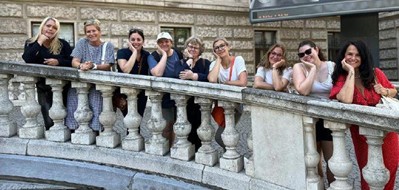
Foto: Kindergarten-Team Rauchvilla © Anna-Maria Haas
Vienna – Kindergarten Schmetterling, Dornbach:
The kindergarten is a private, bilingual kindergarten in the 17th district of Vienna. Size: round about 60 children from ages 1-6. Staff: pedagogical team: 7, other team: 13
The facility consists of various group rooms, an exercise room, a creative area for crafts and painting, and a large garden with playground equipment and a vegetable garden. Activities include trips to the nearby park, museums and sports activities. In the summer, the kindergarten becomes a toy-free kindergarten. This particularly encourages the children’s creativity. Goodbye to an abundance of toys!
The children play in the mud, play tag, and build creative cardboard huts. Director Elvira Lhotka is convinced of this approach, as it allows children to focus on the essentials of being a child. Sustainability is a top priority for the director: since 2024, the facility has been awarded the Austrian Ecolabel. The collaboration with Südwind began in the spring of 2025.
Introduction / Start
Salzburg:
Cooperation with Kindergarten Rauchvilla started in autumn 2024 when we met to talk about how to work with younger children on the SDGs, and the kindergarten talked about the activities they were already doing and how they were starting to raise awareness.
First goal was to establish good cooperation and involve the pedagogical team in the Creative Storytellers activities such as the Webinars, the online course. They were also consulted for the country report and gave feedback to the SDG Matching charts. They work a lot with books: Reading aloud, storytelling together, painting and crafting, or role-playing are seen as wonderful ways to address topics such as environmental protection, equality and tolerance, peace and cohesion.
To discuss and think about what all living beings -humans as well as animals- and our planet need to be healthy and happy is an important part included in the kindergarten’s activities. Südwind provided a bookcase with 70 picture books about topics related to SDGs on loan at the start of the collaboration. Also, parents were informed about the planned activities at an early stage.
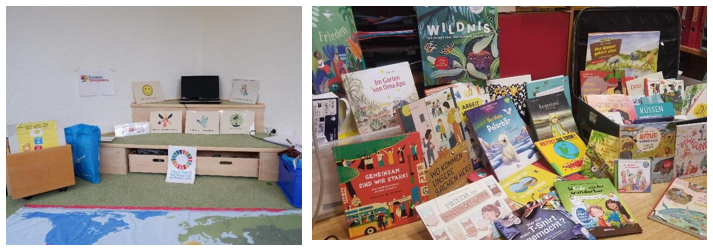
Foto: 20250515_Creative Storytellers Material (c) Südwind
Vienna:
The kindergarten approached Südwind in early 2025 because they needed support with a zero-waste summer party. Südwind advised the facility on this matter, drawing on its expertise from various other certified sustainable events. This included the purchase of a composter, which remained at the kindergarten after the party and is now used to produce its own humus for the kitchen garden. Book recommendations for working with children on this topic were also exchanged. The kindergarten has been awarded the Austrian Ecolabel and generally attaches great importance to sustainability.
Topics / SDGs Chosen
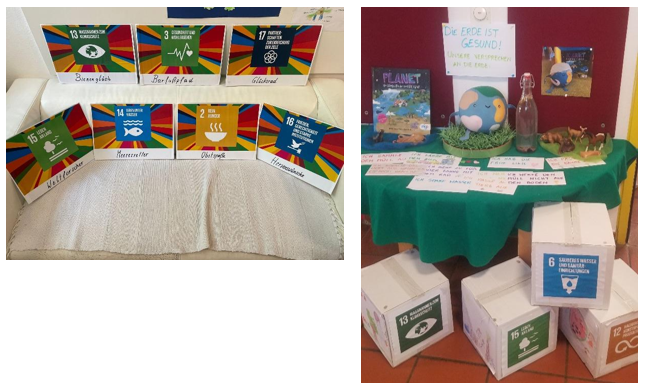
Foto: ausgewählte SDGs; Tisch im Kindergarten (c) Anna-Maria Haas
Salzburg:
The kindergarten already started their activities about SDGs already before the Creative Storytellers Project started. The impetus for this came from the publication Explorers for the Global Goals, a resource from World’s Largest Lesson, translated into German by Südwind. The kindergarten worked with that and caught fire for the topic. They realised that there are lots of activities which are already done in kindergarten which can be connected easily to the different aspects of sustainability – and also to the Austrian Kindergarten Curriculum (Bildungsplan), which is the conceptual basis for educational work. So they started to work on dfferent SDGs. Later on they also worked with the SDG book collection “17 Ziele, 70 Bücher” of Südwind
For the SDG Fest they chose SDGs 2,3, 13,14,15,16,17. The Kindergarten chose goals of nearly all P´s: out of People, Planet, Peace and Partnership. A parkour with activities for each goal was planned to be prepared and all families would get invited to participate.
Vienna:
The Schmetterling kindergarten focuses on the following SDGs: SDG 12 – Sustainable consumption and production, SDG 13 – Climate action, SDG 4 – Quality education, SDG 10 – Reduced inequalities. These are the goals that are the focus of the team’s daily interactions and activities. These goals are particularly relevant to the local context. In their daily work, they see how important it is to make environmental protection, waste prevention, and the conscious use of resources tangible for children.
At the same time, families from different cultures are part of the Kindergarten. Intercultural and language learning (SDGs 4 & 10) is therefore an integral part of their everyday life. These topics are of great interest to the children and can be wonderfully integrated into the educational plan through play and projects. They use stories, role-playing games, and creative projects, especially the toy-free kindergarten during the summer months, to teach the SDGs in a child-friendly way. For example:
- A “garbage monster” project shows children how to separate waste properly.
- In the “world explorer circle,” stories from different cultures are told, promoting linguistic diversity and tolerance.
And in the toy-free kindergarten, children build their own toys from recycled materials, learning sustainable thinking through play.
Co-Design Labs
Salzburg:
The invitation to the Co Design Lab was sent out through an email from the nursery manager. She invited all parents and families to come to the nursery on the afternoon of 15 May 2025 at 3:30 p.m. for a storytelling session. Fourteen adults took part in the activity with sixteen children, plus three teachers (a total of 33 people) and the Südwind employee. We spent two hours storytelling, presenting the project and discussing the topic. Everyone got creative in the storytelling workshop and began transforming their ideas on the SDGs Reduced Inequalities (15), Climate Action (13) and Life Below Water (14) into stories, song lyrics and audio contributions. We worked on stories in three groups, creating fragments, text modules and videos that were used to develop stories about the sun, Timo the zebra, Mina the fish. Of course, the stories were not finished that afternoon; further work was done in the following weeks by the group leaders and Südwind.
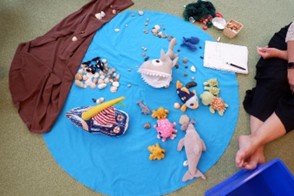
Activities included this afternoon were: Playing with objects and animals related to the sea, music, using scarves and dancing together, making climate hero masks and watching a short film explaining the SDGs.
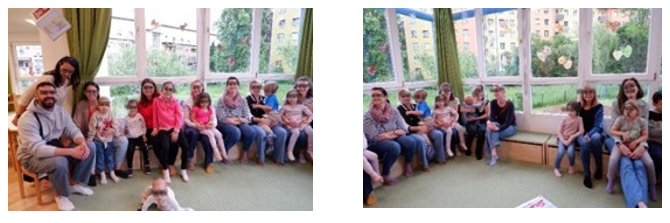
SDG Fest
Sommerfest Salzburg:
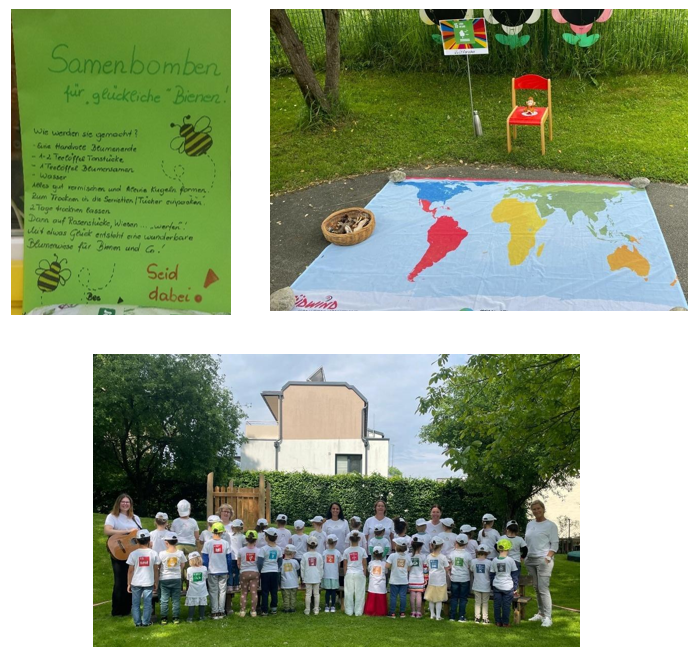
Fotos: Samenbomben_SDG Day, SDG Gruppenfoto, Tuchkarte_SDG15
Salzburg:
The Rauchvilla nursery school implemented the SDG motto at this year’s summer festival. There was a SDG song and a parkour with different activities for the families: seed bombs were made for ‘Life on Land’ and the habitat of animals was discussed, the “sea” was cleaned of plastic for ‘Life Under Water’, healthy eating was celebrated with homemade fruit skewers, and the children’s heart’s desires were brought to life. In addition to that there was a SDG Quiz Wheel to also inform parents deeper about this topic – this part was done by Südwind staff.
About 110 people (kids, parents and some grandparents) were present this afternoon. The Highlight was at the beginning of the event when the children performed their SDG song. The team created the text of the song (in rhyme).
Vienna:
SDG Day – Zero Waste Summer Festival at Kindergarten Schmetterling, Dornbach
Date: 13.06.2025; Approx. 100 people were present that afternoon
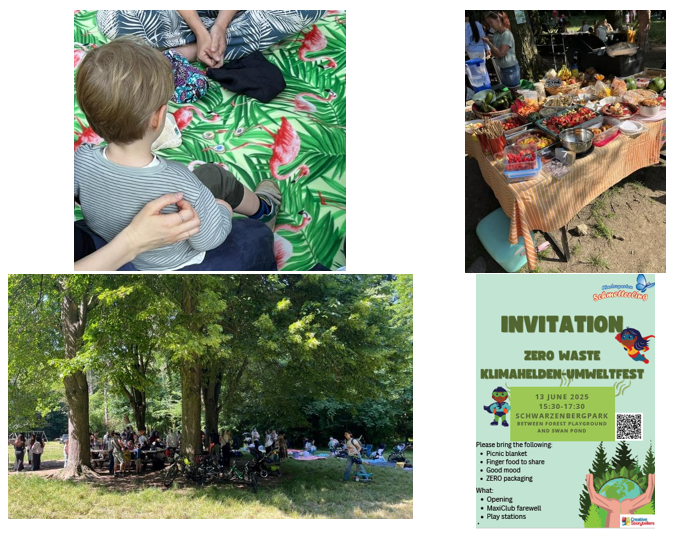
Fotos: 20250613_ZeroWasteUmweltfest_(c)Südwind_1-3
Most of the children took part in the summer party with their parents, and there were also supervised stations by people from outside the kindergarten, such as myself from Südwind with the storyteller station, a dance station and an engineering for kids station. There was zero-waste food and the composting plant purchased for the kindergarten was inaugurated. Canisters and cups from the City of Vienna were available to borrow for drinks. These were also financed with funds from the project.
After a performance by the children and the farewell of the older children to school, there was a lively celebration. The children visited the stations, played, ate and made lots of crafts. During the summer vacation care, the kindergarten switches to a toy-free kindergarten model, in which children only play with toys they have made themselves or play toy-free games.
Produced Stories
Title: Plastik im Meer
SDG Focus: SDG 14
How it was made:
This story began with a discussion group on life underwater in Anna-Maria’s nursery school class. The children’s knowledge about the seas and aquatic animals was gathered, problems were discussed and the children’s ideas were written down. The teacher used this information to create text modules. An online tool was used to turn the text modules into a song and the background image was enhanced with some animations.
Title: Timo, das Zebra mit nur einem Streifen
SDG Focus: SDG 16, 10
How it was made:
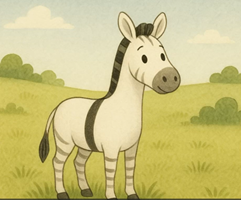
In the storytelling workshop, Laura Walch’s group worked on the topic ‘Are we all the same? How are we different? Is anyone being excluded?’ The group of children and parents developed the plot and ideas (solutions and texts), which were then turned into a story about tolerance, solidarity and individuality by the teacher, who also added the animations. On another day, the story was recorded as an audio file with a group of children, with the teacher and the children playing different roles. The editing and sound were done using the CapCut tool.
Title: Die Sonne ist verschwunden
SDG Focus: SDG 11, 13, 15
How it was made:
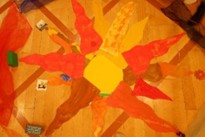
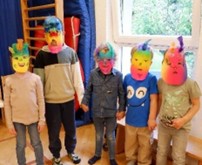
The teacher Donata prepared materials to address the topic of environmental pollution: a paper sun and sunbeams painted together, along with some wooden toys that could serve as inspiration for the children. At the beginning, with the children and parents sitting in a circle around it, the sun was covered with a dark cloth and the teacher told the story of how one day the sun disappeared. Together, they thought about why it might have disappeared and how the problem could be solved. To finish, they made climate hero masks, sang a song together and danced to it.
Title: Kasperl und Prinzessin über die Schule, Strom und die Erde
SDG Focus: SDG 4, 7, 13, 15
How it was made:
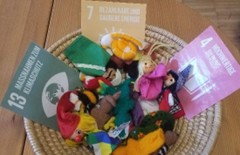
Children had the opportunity to choose single goals and use finger puppets to invent stories to go with them.
Kasperl, a well-known character, offered to help. Later on the audio was shortened.
Story Stone-afternoons
As part of the Zero Waste Summer Festival and the days that followed, stories on sustainability topics were invented using thematically prepared story stones. The focus here was on the children’s creative freedom. Anything was allowed. The children were motivated and had a lot of fun inventing the stories. The outcome was a series of short audio stories, which are listed here:
Mina der Fisch Plastik im Meer SDG14 4 audio